Medical & Dental Clinic Cleaning Supplies: The Complete Australian Guide
Last updated: October 2026
Medical and dental clinic cleaning supplies centre on five groups: TGA-approved hospital-grade disinfectants, an alcohol sanitiser for high-touch surfaces, colour-coded cloths and mops, single-use gloves, and clinical waste disposal. Add hand hygiene consumables and a documented cleaning schedule, and the kit meets the infection-control standard Australian practices are assessed against.
Cleaning a medical or dental practice is not the same job as cleaning an office. Almost every surface in a treatment room sits between two patients, so the cleaning standard is set by infection-control guidance rather than by appearance. Australia's NHMRC Australian Guidelines for the Prevention and Control of Infection in Healthcare and the Australian Commission on Safety and Quality in Health Care both expect a practice to clean by risk: clinical areas get a product with a proven kill claim, administrative areas get a detergent clean, and the paper trail matters as much as the bucket.
This guide covers the clinic cleaning supplies Australian GP surgeries, dental practices, physiotherapy rooms, pathology collection centres and day clinics order most often, the products that actually satisfy a hospital-grade disinfection standard, and the schedule that keeps an accreditation visit straightforward.
On this page:
- Hospital-grade disinfectants
- Clinical waste and sharps disposal
- Hand hygiene: soap, sanitiser and dispensers
- Gloves and disposable PPE
- Surface cleaning: wipes, cloths and colour coding
- Floor care and wet floor safety
- A cleaning schedule by clinic area
- Infection-control obligations to document
- Clinic cleaning supplies checklist
- Frequently asked questions
1. Hospital-Grade Disinfectants: The Core of Clinic Infection Control
A disinfectant only does what its label says it does. In a clinical setting that label needs three things: a TGA listing or ARTG number, a stated kill claim against the organisms you care about, and a contact time your staff can realistically achieve between patients. A pleasant-smelling cleaner with no kill claim is a detergent, not a disinfectant, and it will not satisfy an infection-control auditor.

TGA-approved surface disinfectants
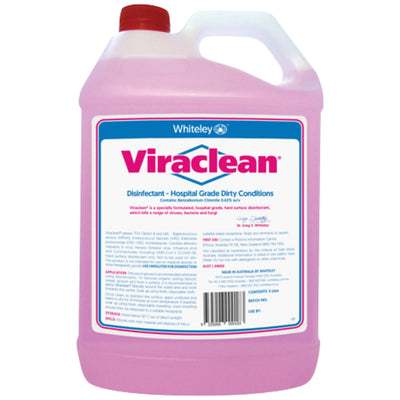
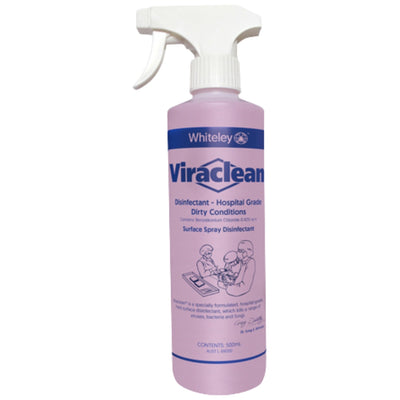
Viraclean Hospital Grade Disinfectant is the workhorse in most practices. It is a ready-to-use surface disinfectant registered with the TGA (ARTG No. 103753) with efficacy claims against SARS-CoV-2, influenza, MRSA and E. coli, and it needs no dilution. The 5L refill suits a utility room; the 500ml ready-to-use spray lives on the trolley for chair-side and consult-room wipe-downs. For a deeper product comparison, see our guide to hospital grade disinfectant.
Concentrated disinfectant cleaners
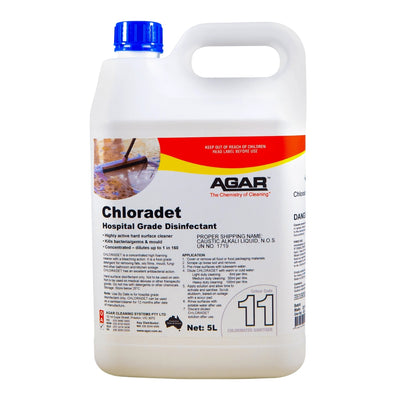
Where the soil load is heavier, a concentrated disinfectant cleaner earns its place. Agar Chloradet is a hospital-grade disinfectant and high-foaming cleaner with a bleaching action that lifts mould and staining from tiles, walls, baths and shower recesses, and it dilutes up to 1 in 160 so a single 5L drum covers a lot of amenity space.
Alcohol sanitisers for high-touch surfaces
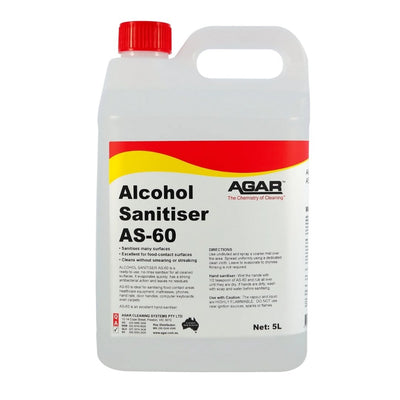
Door handles, keyboards, treatment chairs, BP cuffs and workstations are the shared surfaces that carry organisms between people. These want a fast, residue-free alcohol wipe-down rather than a wet clean. Agar AS60 Alcohol Sanitiser is a no-rinse, 75% v/v (60% m/v) alcohol sanitiser that air-dries without streaking and is approved for hard surfaces, including equipment and high-touch points. Keep a trigger bottle of it at reception and in every consult room.
Choosing a disinfectant for clinical settings
- Match the claim to the risk. Body-fluid and instrument-adjacent surfaces want a hospital-grade product with a specific kill claim; waiting-room furniture and office desks do not.
- Check the contact time. If the surface must stay wet for five minutes, that is five minutes you must schedule. Alcohol sanitisers are popular in clinics precisely because they dry in seconds.
- Keep the SDS and the dilution chart on site. Under WHS law, staff need access to safety data sheets and correct dilution instructions. See our guide to commercial cleaning chemical storage for a compliant utility-room setup.
- Do not mix chemistry. Bleach-based and quaternary-ammonium products belong in separate buckets with separate cloths.
2. Clinical Waste and Sharps Disposal
Waste separation is where a clinic most visibly complies or does not. General waste, mixed recycling and clinical or contaminated waste need separate, clearly marked containers, and the annual cleaning consumables order should account for all three streams.
General waste and recycling bins
Enviroplus Envirobin 60L bins use a lid-colour system that makes the correct stream obvious at a glance, from waiting room to staff kitchen. The yellow mixed-recycling lid pairs with the red landfill body for a two-bin setup in reception.
Sanitary and washroom waste
Any practice with a public or staff washroom needs hands-free sanitary disposal. The Puregiene pedal-operated sanitary bin lifts without hand contact, which removes the most common cross-contamination point in a washroom, and it is serviceable in seconds.
Sharps and contaminated waste
Sharps containers and clinical waste bins are regulated items in most states, and the collection contractor usually supplies them under a service agreement. What the cleaner controls is the secondary containment: a correctly sized bin liner that does not split, and a clean, labelled bin position that staff can reach without carrying an open container down a corridor. Never decant clinical waste to save a bag, and never place it in the general-waste stream.
3. Hand Hygiene: Soap, Sanitiser and Dispensers
Hand hygiene is the single most effective infection-control measure in a clinic, and it depends entirely on consumables being stocked and dispensers working. If a dispenser is empty, staff and patients default to nothing.
Soap at every hand basin
Clinical hand-washing points need liquid or foam soap, not bars. A bulk-fill system keeps the cost per wash down and the refill cadence predictable. Pair wall-mounted soap dispensers with a paper towel dispenser at each basin so hand drying never depends on a shared towel.
Alcohol-based hand sanitiser
Place sanitiser where the five moments of hand hygiene actually happen: at the entry to every treatment room, at reception, and at the door of every consult room. A touchless dispenser reduces contact points and is the practical choice for high-traffic areas. The Puregiene automatic bulk-fill sanitiser dispenser is battery powered, touch-free and takes a 1L bulk fill, so it needs no cartridge repurchasing.
Paper hand towels and dispensing
Interleaved hand towels dispense one at a time, which limits both waste and the transfer of organisms from a shared stack. The Puregiene Ultraslim interleaved hand towels (carton of 2,400) fit standard ultraslim dispensers, and the ultraslim plastic dispenser mounts in the tightest washroom. For a full fold-type breakdown, see our interleaved hand towels guide.
4. Gloves and Disposable PPE for Clinic Cleaning
Cleaning staff need their own gloves, separate from the clinical gloves used for patient care. Consider the task, not just the box price.

- Nitrile for chemical work. Nitrile resists punctures, oils, solvents and disinfectant chemicals, which is what you want when handling concentrated products. Puregiene powder-free nitrile gloves come boxed in 100s in a full size range, and powder-free matters in a clinical setting.
- Fit beats thickness. A glove that is too loose reduces grip on wet surfaces and lifts at the cuff. Our nitrile gloves buying guide covers sizing and material selection in detail.
- Change between zones, not between rooms on a timer. Gloves worn from a washroom into a treatment room are a transmission route, not a control.
5. Surface Cleaning: Wipes, Cloths and Colour Coding
The cloth is the piece of equipment most often overlooked and most often responsible for spreading contamination from a bathroom to a bench.
Disinfectant wipes for equipment and high-touch points
Pre-saturated wipes are the fastest way to disinfect a BP cuff, a phone handset or a treatment chair arm between patients. V-Wipe hospital-grade disinfectant wipes come in a 100-wipe tub that keeps the solution at strength, and a wall-mounted wipe dispenser keeps them off the bench and within reach. For higher-volume areas, Wow Wipes antibacterial wipes are supplied by the carton of 4,800.
Microfibre and the colour code
Colour coding is now expected practice, not a nice-to-have. Assign one colour per zone (for example red for washrooms and sanitary areas, blue for general surfaces, green for food or kitchen areas, yellow for clinical and treatment surfaces) and never let a cloth cross zones. Our guide to setting up a colour coded cleaning system walks through the whole scheme, and it is worth a read before you place a consumables order.
6. Floor Care and Wet Floor Safety
Clinic floors are hard surfaces, walked in street shoes, and cleaned while patients are moving through the building. Two things matter: the cleaner has to lift soil without leaving a film, and nobody slips on the way past.
- The floor cleaner. A concentrated neutral or heavy-duty cleaner handles vinyl, sealed timber and tile without damaging the finish. Cleanmax Heavy Duty Floor Cleaner is a water-based concentrate with multiple dilution ratios, which suits both a mop-and-bucket routine in consult rooms and a machine clean in corridors.
- The wet floor sign. A cleaning trolley with no signage is a liability in a waiting room. Cleanmax Caution Wet Floor A-frame signs use moulded text that will not fade or peel, fold flat on the trolley, and are the minimum control for a wet corridor.
- Clean dry, working backwards. Clean from the furthest point toward the exit so no one re-walks the wet floor, and dry the surface before moving on where the finish allows.
A Cleaning Schedule for Australian Medical and Dental Clinics
Infection-control guidance is risk-based, so the schedule follows the zones rather than a single blanket rule. A workable pattern for most practices:
- Treatment and consult rooms. Clean and disinfect between every patient: high-touch surfaces first, then the treatment chair, then floors at the end of each session. Terminal clean at end of day.
- Reception and waiting areas. High-touch points (counter, door handles, seats, magazines removed) at least twice daily, full vacuum and damp mop daily or every second day by traffic.
- Washrooms. Cleaned and disinfected at least twice daily, with sanitary bins checked and hand soap, sanitiser and paper towels restocked on every visit.
- Staff and storage areas. Damp clean daily, with chemical storage inspected weekly for correct labelling, dilution charts and SDS availability.
- Clinical waste. Removed at least daily and whenever a container is three-quarters full, using the correct liner and colour stream.
Infection-Control Obligations to Document
What gets a practice into trouble is rarely the cleaning itself, it is the absence of evidence. Keep a simple, auditable record:
- A cleaning schedule that names the area, the frequency and the product used. The ACSQHC infection-control standard expects cleaning to be documented and auditable.
- Product evidence. Keep the TGA or ARTG reference and the kill claims for every hospital-grade product on site so you can demonstrate you cleaned to a standard, not just to a smell.
- Staff training and PPE records. Cleaning and clinical staff should both be trained in the practice's infection-control policy, and the training and the PPE issued recorded.
- WHS compliance for chemicals. Safety data sheets, correct dilution, labelled containers and suitable gloves are all part of the same obligation as the clinical clean.
Clinic Cleaning Supplies Checklist
- Hospital-grade surface disinfectant (5L refill + 500ml ready-to-use spray)
- Alcohol sanitiser, no-rinse, for high-touch surfaces
- Concentrated disinfectant cleaner for amenity and wet areas
- Disinfectant wipes tubs and a wall-mounted wipe dispenser
- Nitrile gloves, powder-free, multiple sizes, by the box
- Colour-coded microfibre cloths and mop heads
- Hand soap and a bulk-fill or manual soap dispenser per basin
- Touchless hand sanitiser dispenser, 1L bulk fill
- Interleaved paper hand towels and a dispenser per basin
- Liners and the correct colour-coded bins for general, recycling and sanitary waste
- Pedal-operated sanitary bin
- Concentrated hard-floor cleaner
- Caution wet floor signage
If you would rather not assemble that list by hand, our aged care cleaning supplies guide uses the same logic in a different setting and shows how the categories map across healthcare environments.
Frequently Asked Questions
What disinfectant should a medical clinic use?
Use a TGA-registered, hospital-grade surface disinfectant with a stated kill claim and an achievable contact time. Viraclean (ARTG No. 103753) is a common choice for ready-to-use surface disinfection, and a 75% alcohol sanitiser such as Agar AS60 covers fast wipe-downs of high-touch equipment between patients.
How often should a dental clinic be cleaned?
Treatment and consult rooms need cleaning and disinfection between every patient and a terminal clean at the end of the day. Reception and waiting areas want high-touch cleaning at least twice daily, washrooms twice daily, and floors daily or every second day depending on traffic.
Is regular disinfectant enough, or do clinics need hospital-grade products?
Clinical and body-fluid-contact surfaces need a product that meets the hospital-grade standard with proven kill claims. Waiting-room furniture, office desks and general admin areas can be cleaned with a standard detergent or disinfectant cleaner, because the risk of transmission there is lower.
How should clinical waste be disposed of in a medical practice?
Clinical and contaminated waste must be separated from general waste into clearly marked, correctly lined containers and collected at least daily or when three-quarters full. Sharps go in approved sharps containers supplied under the collection service agreement, never in general waste or an open bin.
What gloves should clinic cleaning staff wear?
Powder-free nitrile gloves are the practical choice: they resist punctures, oils, solvents and disinfectant chemicals, and they suit repeated task changes through a shift. Cleaning staff should have their own gloves, separate from the clinical gloves used for patient care.
Order Medical and Dental Clinic Cleaning Supplies Australia-Wide
Matthews Cleaning Supplies stocks hospital-grade disinfectants, alcohol sanitisers, clinical and washroom consumables, gloves, hand hygiene dispensers and floor care for practices across Australia. Bundle to a single account, get trade pricing on bulk, and keep an audit-ready consumables record.
Shop disinfectants and sanitising products online, or browse the full range at Matthews Cleaning Supplies.
Shop this guide