
How to Read a Safety Data Sheet (SDS): A Plain-English Guide for Cleaning Teams

A Safety Data Sheet (SDS) tells you what a chemical can do to people and property, how to use and store it safely, and what to do if something goes wrong. Every hazardous chemical supplied in Australia must come with one, and every SDS follows the same 16-section layout. Once you know where to look, you can find what matters in under a minute.
This guide walks through each section in plain English, highlights the five that cleaners actually need, and explains the hazard pictograms you will see on labels.
Table of contents
- What an SDS is and who must have one
- The five sections cleaners need
- All 16 sections explained
- Hazard pictograms and signal words
- Worked example: bleach
- Keeping your SDS register current
- Frequently asked questions
What an SDS is and who must have one
An SDS, previously called a Material Safety Data Sheet (MSDS), describes the properties of a hazardous chemical and how it affects health and safety at work. Australia uses the Globally Harmonized System (GHS), and from 1 January 2023 only GHS Revision 7 can be used for new classifications, labels and SDS.
The responsibilities split three ways:
- Manufacturers and importers prepare the SDS and must review it at least every five years.
- Suppliers provide the current SDS with the product.
- Workplaces that use hazardous chemicals keep the current SDS somewhere workers can get to it, and use it to manage risk. Our chemical storage guide covers the register and storage side.
The five sections cleaners need
Most of an SDS is written for chemists, transport companies and regulators. For day-to-day cleaning, five sections do the work:
| Section | What it tells you | Use it to |
|---|---|---|
| 2. Hazard identification | The hazard class, signal word, pictograms and hazard statements | Decide how careful staff need to be and whether the product needs locked storage |
| 4. First aid measures | What to do for skin, eye, inhalation and swallowing exposure | Brief staff and post next to the chemical store |
| 7. Handling and storage | Safe handling, temperature limits and what not to store nearby | Set up shelves and segregation |
| 8. Exposure controls and PPE | Gloves, eye protection, ventilation and exposure limits | Choose the right gloves and goggles |
| 10. Stability and reactivity | Incompatible materials and dangerous reactions | Stop chemicals being mixed, such as bleach with acids |
Turn those five sections into a one-page task card per chemical and keep it with your spray bottles. It is far more likely to be read than a ten-page SDS.
All 16 sections explained
- Identification: product name, recommended use, supplier details and an Australian emergency phone number.
- Hazard identification: GHS classification, pictograms, signal word and hazard and precautionary statements.
- Composition: the hazardous ingredients and their concentrations.
- First aid measures: what to do after exposure, by route.
- Firefighting measures: suitable extinguishers and fire hazards.
- Accidental release measures: how to contain and clean up a spill, and the PPE to wear.
- Handling and storage: safe use and storage conditions, including incompatible materials.
- Exposure controls and personal protection: exposure limits, ventilation and PPE.
- Physical and chemical properties: appearance, odour, pH, flash point and similar data.
- Stability and reactivity: conditions and materials to avoid.
- Toxicological information: health effects, short and long term.
- Ecological information: effects on waterways and the environment.
- Disposal considerations: how to dispose of the product and container.
- Transport information: dangerous goods class and UN number, if any.
- Regulatory information: poisons schedule and other rules that apply.
- Other information: the date the SDS was prepared or last reviewed, and any changes.
Two quick checks catch most problems: the date in Section 16 should be within the last five years, and the product name in Section 1 should exactly match the product on your shelf.
Hazard pictograms and signal words
GHS pictograms are red diamonds with a black symbol, and they appear on both the label and Section 2 of the SDS. The ones cleaning teams see most often are:
- Corrosion (liquid eating into a hand and a surface): can burn skin, damage eyes or corrode metal. Common on bleach, acid toilet cleaners, descalers and strong degreasers.
- Exclamation mark: irritant to skin or eyes, or harmful if swallowed. Common on detergents and many general cleaners.
- Flame: flammable. Common on alcohol sanitisers, methylated spirits and aerosols.
- Environment (dead fish and tree): toxic to aquatic life, so never tip it down a stormwater drain.
- Health hazard (person with a star on the chest): can cause serious longer-term health effects.
The signal word tells you how serious the hazard is. Danger is used for the more severe hazards, and Warning for the less severe ones. A product with no pictogram and no signal word is usually not classified as hazardous, but still check Section 2.
Worked example: bleach
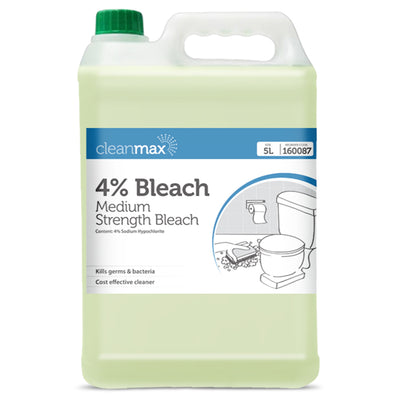
Take a typical sodium hypochlorite bleach such as Cleanmax Bleach 4% 5L. Reading the five key sections of a bleach SDS usually tells you:
- Section 2: corrosive or irritant to skin and eyes, depending on strength, with the corrosion or exclamation mark pictogram.
- Section 4: rinse eyes and skin with running water for an extended period and seek medical advice.
- Section 7: store cool, out of sunlight, in the original container, away from acids.
- Section 8: chemical-resistant gloves and eye protection when decanting or using at strength.
- Section 10: reacts with acids and ammonia to release toxic chlorine or chloramine gas. This is why bleach must never be mixed with acid toilet cleaners.
Always read the SDS for the exact product you hold, because strengths, ingredients and advice vary between brands.
Keeping your SDS register current
- List every chemical on site with its location, quantity and SDS date. Our chemical storage guide includes a register layout.
- Check dates once a year. Replace any SDS older than five years with the supplier's current version.
- Add new products before first use, not after. Nothing new goes on the shelf without its SDS.
- Remove SDS for products you no longer use, so staff are not reading the wrong sheet.
- Keep it reachable. A folder in the chemical store plus a digital copy staff can open on a phone.
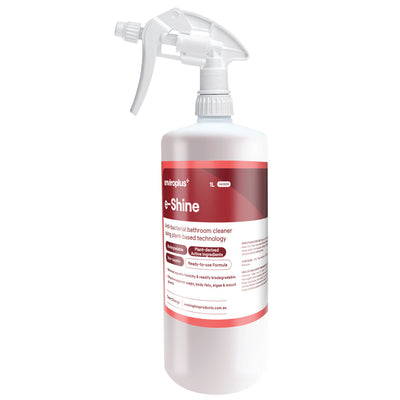
- Label every decanted bottle. Pre-labelled kits such as the Enviroplus e-Shine spray bottle kit make this easy. See our guide to labelled spray bottles.
PPE named in Section 8 should be on site and in the right sizes. Puregiene Heavy Duty Nitrile Gloves suit most cleaning chemicals, and our nitrile gloves guide covers thickness and fit.
Frequently asked questions
What is the difference between an SDS and an MSDS?
They are the same document under a newer name. Australia replaced the Material Safety Data Sheet (MSDS) with the Safety Data Sheet (SDS) when it adopted the Globally Harmonized System, which fixed the format at 16 sections in a set order.
How old can a Safety Data Sheet be?
Manufacturers and importers must review each SDS at least every five years. If the issue or review date on your copy is more than five years old, ask your supplier for the current version.
Which SDS sections matter most for cleaners?
Section 2 (hazards), Section 4 (first aid), Section 7 (handling and storage), Section 8 (PPE and exposure controls) and Section 10 (what not to mix it with). Together they tell staff what can go wrong, how to prevent it and what to do if it happens.
Do I need an SDS for every cleaning product?
You need a current SDS for every hazardous chemical used at your workplace, and it must be easy for workers to get to. Many cleaning chemicals, including bleach, degreasers and acid cleaners, are hazardous. If you are unsure, ask the supplier for the SDS and check Section 2.
Where should SDS be kept on a cleaning site?
Somewhere staff can reach them quickly, usually a folder in the chemical store or cleaner's cupboard, plus a digital copy on a shared drive or phone app. Multi-site cleaning teams should keep a copy at each site where the chemical is stored.
Need an SDS for a product you bought from us?
Email Shop@matthewscleaningco.com.au with the product name and we will send the current version. Browse our full range of cleaning chemicals, or read detergent vs sanitiser vs disinfectant to choose the right product for each job.
Sources: Safe Work Australia, Preparing safety data sheets; WorkSafe Queensland, Globally Harmonised System. This guide is general information. Always read the SDS for the exact product you use.
Shop this guide
 Puregiene Heavy Duty Nitrile Gloves — Blue, Large, Box of 100
$16.13 inc GST
Buy 10+ and save $1.62 each
Written by
Jordan MatthewsCommercial cleaning specialist at Matthews Cleaning Company. Our expert team draws on years of hands-on field experience to help businesses choose the right tools and chemicals for every cleaning challenge.


