
Hotel & Accommodation Cleaning Supplies: The Complete Housekeeping Guide for Australian Accommodation

A hotel housekeeping kit runs on three groups of supplies: guest amenity consumables such as foam soap, bodywash and tissue; room-cleaning chemicals and cloths such as glass cleaner, neutral surface cleaner and colour-coded microfibre; and back-of-house stock including laundry detergent, bin liners and washroom refills. Size each order from your room count and measured usage, not from guesswork.
What this guide covers
- What supplies a hotel housekeeping team actually needs
- Guest amenity consumables: what guests notice first
- The housekeeping cart: your biggest time saver
- Cleaning equipment for room-to-room work
- Public washroom and back-of-house supplies
- Laundry: in-house or outsourced
- A room-clean sequence that cuts chemical use
- Compliance and safety for accommodation sites
- Consumption planning: how much to order
- Frequently asked questions
What supplies a hotel housekeeping team actually needs
Hotel cleaning supplies are usually bought as one undifferentiated list, which is why storerooms fill up with the wrong things. Split the list into three groups and each group becomes easy to specify, store and reorder.
- Guest amenity consumables. The items a guest uses directly: hand soap, bodywash or shampoo, facial tissue, toilet tissue, seat seals and odour control. These are a guest-experience line item, so consistency of brand and format matters as much as price.
- Guest room cleaning chemicals and cloths. Glass and mirror cleaner, a neutral surface cleaner for hard surfaces, bathroom cleaner and a colour-coded cloth set. This is where dilution control and labelling pay for themselves.
- Back-of-house consumables. Bin liners, laundry detergent and softener, washroom hand towels, urinal screens, sanitary bin liners and any public-area floor care items.
Keeping the three groups separate in the storeroom stops chemicals being stored beside food-contact or amenity items, and it makes a stocktake something a supervisor can finish in ten minutes. If you are still working out shelf-to-cart logistics, our guide to commercial cleaning trolleys covers the equipment side.
Guest amenity consumables: what guests notice first
Guests rarely comment on the floor. They do notice empty soap dispensers, thin tissue and a bathroom that smells tired. Amenity consumables are the cheapest part of the room to control and the fastest to show up in reviews.
Hand soap, bodywash and shampoo
Touch-free dispensers have become the standard in Australian accommodation because they remove a shared point of contact and dose more accurately than manual pumps. Two refill formats cover almost every setup:
- Foam soap cartridges for automatic dispensers, in cartons of six 1 litre refills. Foam lathers on a smaller dose, so each refill lasts longer than a liquid equivalent, and the click-in cartridge means no pouring and no spills on the vanity.
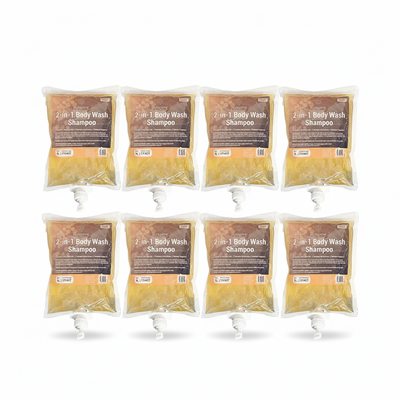
- 2-in-1 bodywash and shampoo in cartons of eight 1 litre refill pouches. One SKU covers shower and basin in guest bathrooms, which simplifies both the dispenser layout and the reorder.
The Puregiene luxury foam soap refill for auto dispensers is formulated with aloe vera and vitamin E for premium washrooms, while the Puregiene bodywash and shampoo refill carton is designed for shared amenities and accommodation venues where a single dual-purpose product keeps restocking simple.

Tissue: facial in rooms, toilet tissue in cubicles
Match the roll format to the dispenser already on the wall. A 300 metre jumbo roll will not fit a compact domestic holder, and a 400 sheet roll rattles around in a jumbo unit, wasting paper on every pull.
- 2-ply 200 sheet facial tissue in cartons of 30 boxes for rooms, reception counters and waiting areas.
- 2-ply virgin jumbo toilet tissue, 300 metre rolls in cartons of eight, for high-traffic public washrooms and back-of-house amenities.
- 2-ply 400 sheet toilet tissue in cartons of 48 for standard cubicle holders in lower-traffic areas such as staff and service corridors.
If your dispensers themselves are due for review, start with the hardware guide to commercial toilet paper dispensers before you lock in a roll SKU.
Seat seals and odour control
Two low-cost items lift the perceived standard of a bathroom more than any deep clean: toilet seat seals, supplied in cartons of 2,000, and a metered air freshener. A 250 millilitre metered canister delivers up to 6,000 timed sprays and, on a typical 15 minute cycle, runs for roughly 30 days, so a ten pack covers up to 60,000 sprays and turns servicing into a monthly task instead of a daily one.
The Higieneco metered air freshener refill pack fits most battery or mains powered 250 millilitre metered dispensers and uses a dry micro-mist that leaves no residue on floors or fixtures. In corridors and lift lobbies, put the dispenser on the wall rather than the ceiling so the servicing technician can reach it without a ladder.
The housekeeping cart: your biggest time saver
Housekeeping labour is lost on trips, not on cleaning. A single-cart round that carries everything for a floor removes most of the walking from a shift.
The Cleanmax janitors cart with bag is the format that suits accommodation work: three deep shelves for chemicals on the lower tier and amenity stock on top, an integrated bag for waste and soiled linen, and quiet-rolling castors that handle polished corridors, carpet and lift thresholds without marking either.

What a room round cart should carry
- Chemicals: diluted glass cleaner, neutral surface cleaner, bathroom cleaner, and one spray bottle per chemical with a clear label.
- Cloths: a colour-coded set, at least four colours, with separate cloths for bathroom, glass, dusting and general surfaces.
- Amenity stock: soap and bodywash refills, facial tissue boxes, toilet rolls, seat seals.
- Waste and linen: bin liners in the two sizes used in rooms, and a linen bag that keeps clean and soiled items apart.
- Tools: a hand-held vacuum or a lightweight vacuum for stairs, plus a microfibre flat mop for hard bathroom floors.
Restocking the cart once at the start of a shift, rather than topping up mid-round, is the difference between a clean floor run and six trips to the storeroom. Set a fixed pack list per cart and audit it at handover.
Cleaning equipment for room-to-room work
Vacuums: cordless convenience versus corded power
Backpack vacuums dominate commercial accommodation cleaning for a practical reason: the weight sits on the shoulders instead of being dragged up and down stairs, which matters across a multi-level property. A HEPA rated unit also keeps fine dust out of the air in rooms that are about to be occupied.
For sites where WHS compliance is mandated and there is no external safety switch, the Pacvac Superpro backpack vacuum with inline RCD builds the residual current device into the power lead, so no separate adaptor is needed. Cordless models suit quick turndown services; corded units still win on sustained deep cleans.

Glass and mirror cleaning
Bathroom mirrors, shower screens, balcony doors and lift glass are the surfaces guests inspect closest. The Cleanmax 5 litre glass cleaner can be used neat on heavy build-up or diluted for routine work, and is safe on tinted glass and chrome. Pair it with a premium 320 GSM microfibre cloth: the cloth lifts fingerprints and dust with water alone and survives repeated commercial laundering, which keeps chemical use and cloth replacement down.
Colour coding stops cross-contamination between rooms
One cloth for a bathroom and then a benchtop spreads soil through the property faster than any guest moves. Use a fixed colour per zone and keep to it. Our guide to setting up a colour coded cleaning system sets out the standard mapping, and the same logic applies to spray bottles: labelled bottles mean the person picking one up knows exactly what is in it.
Public washroom and back-of-house supplies
Public washrooms take a heavier beating than guest rooms and are usually serviced by a different person on a different pattern. Standardise them so refills are interchangeable:
- Urinal screens in cartons of 12, with enzymatic action that breaks down uric acid, splash reducing bristles and up to 30 days of deodorising per screen in standard or waterless urinals.
- Interleaved or centrefeed hand towels matched to the dispenser format already installed, covered in our guide to interleaved hand towels.
- Jumbo toilet tissue for public cubicles, on the same SKU used in back-of-house amenities.
- Sanitary bins and liners, including the servicing side, covered in the guide to commercial sanitary bins.
Bin liners are worth deciding once and standardising. The 80 litre heavy duty bin liner in a carton of 250 uses a 25 micron LDPE film with a star-sealed base, which is the strength you want for public area and utility bins, while rooms usually run 18 to 36 litre liners in larger cartons. Our bin liner size guide walks through matching liner size to bin size so a liner never bursts at the worst moment.
Laundry: in-house or outsourced
If you wash your own linen, towels or uniforms, the chemistry set is small: a concentrated laundry detergent, a softener, and a destainer for the stains that come with food service and beverage spills. The Agar Taurus concentrated laundry detergent comes in 5 litre bottles, three per carton, and works with front and top loading machines.
Dose to the machine, not to the load size on the bag, and keep the laundries supply out of the guest-facing storeroom. Our guide to commercial laundry chemicals covers detergent, softener and destainer selection in more detail. Even when linen is outsourced, keep a small in-house stain treatment kit and laundry bags on site for the marks that appear after the linen has already come back.
A room-clean sequence that cuts chemical use
Sequence is a specification. Cleaning top to bottom and dry to wet means dust ends up in the vacuum rather than being re-wiped, and it lets you finish with one pass per surface.
- Open curtains, turn on lights, check for maintenance faults while the room is empty, then remove waste and take the linen off the bed.
- Strip the bathroom of used towels and amenities while the linen cart is still in the doorway.
- Damp dust horizontal surfaces from the highest point downwards.
- Clean the bathroom: apply bathroom cleaner, let the dwell time do the work, then agitate with a colour-coded cloth reserved for that zone.
- Clean glass and mirrors last in the bathroom so no overspray lands on a finished surface.
- Vacuum, working from the far corner back towards the door.
- Make the bed and dress the room.
- Restock amenities, tissue and the compendium, then complete a final pass for marks the first clean missed.
Letting a chemical dwell while you do another task is the single biggest time saving in a room clean, and it usually means using less product than scrubbing straight away. It also depends on having a cleaner that can tolerate dwell time without drying out, which is why a good bathroom cleaner and a good neutral cleaner matter more than a big chemical inventory.
Compliance and safety for accommodation sites
Three compliance threads run through housekeeping supplies in accommodation:
- Hazardous chemicals. Under the model WHS laws, cleaning chemicals used at work need a current safety data sheet, correct labelling and a hazardous chemical register. The Safe Work Australia code of practice on managing risks of hazardous chemicals in the workplace sets out the register, labelling and SDS requirements.
- Guest and worker facilities. Work health and safety duties require facilities such as toilets and washing facilities to be clean, safe and in good working order, with consumables like soap and toilet paper replenished regularly. The duties are summarised on the Safe Work Australia duties of a PCBU page.
- Accessibility. Dispenser mounting heights in accessible bathrooms should sit within the reach ranges set by AS 1428.1. Confirm current requirements with your certifier or building surveyor before a fit-out.
Decanting is the other compliance trap. If you dilute concentrate into a spray bottle, the bottle needs a proper label and the container needs to be the right type for the chemical. Our guide to labelled spray bottles covers the practical side of that workflow.
Consumption planning: how much to order
Most accommodation sites either over-order and tie up cash in a storeroom, or under-order and buy emergency packs at retail prices. Both problems come from ordering by feel. Measure once, then set min and max stock levels and let the numbers drive the order.
The two week measurement method
- Count placements, not rooms: dispensers, cubicles, urinals, bins and tissue points.
- Run a two week measurement of one full refill cycle per placement and note how long each refill actually lasts.
- Multiply out to your ordering period, then add a 15 to 20 percent buffer for peak season.
- Set a minimum reorder point at roughly two weeks of usage and a maximum at one delivery cycle plus one week.
Carton maths for common hotel lines
- Foam soap refills (6 per carton): number of dispensers, multiplied by refills used per month, divided by six.
- Bodywash and shampoo pouches (8 per carton): shower placements, multiplied by pouches per month, divided by eight.
- Jumbo toilet tissue (8 rolls per carton): public cubicles, multiplied by rolls per month, divided by eight.
- Standard toilet tissue (48 rolls per carton): staff and service cubicles, multiplied by rolls per month, divided by 48.
- Facial tissue (30 boxes per carton): boxes per month across rooms and front desk, divided by 30.
- Metered air fresheners (10 per pack): one canister covers roughly 30 days per dispenser, so ten dispensers need one pack a month.
- Urinal screens (12 per carton): number of urinals, with a monthly replacement cycle, divided by 12.
- Bin liners (250 per carton at 80 litres): total bins, multiplied by liner changes per week, divided by 250.
Once those four numbers per line are in a spreadsheet, seasonal pricing and supplier changes stop being guesswork, and a new property can be brought onto the same standard in a single order.
What cleaning supplies does a hotel need?
A hotel needs three groups of supplies: guest amenity consumables such as hand soap, bodywash, facial tissue, toilet tissue and seat seals; room cleaning chemicals and cloths such as glass cleaner, neutral surface cleaner and colour-coded microfibre; and back-of-house stock including laundry chemicals, bin liners, hand towels and urinal screens.
How often should hotel rooms be cleaned?
Occupied rooms are normally serviced daily with a linen and amenities refresh, and a full departure clean is done between guests. High-touch points such as remotes, switches, door handles and bathroom fittings should be cleaned and disinfected on every service, and any room should be re-checked before a new guest arrives.
What soap do hotels use in guest bathrooms?
Most Australian hotels use a foam or liquid hand soap supplied as a 1 litre cartridge or pouch refill for a wall-mounted dispenser, often paired with a 2-in-1 bodywash and shampoo refill in the shower. Touch-free dispensers are the current standard because they reduce contact points and dose more consistently than manual pumps.
Do housekeeping carts need to be locked or stored securely?
Carts holding chemicals should be stored in a controlled area when not in use, and any cart left in a corridor should not leave chemicals accessible to guests. Chemicals on the cart need to be labelled and matched to a current safety data sheet, in line with the model WHS hazardous chemicals code of practice.
How do I stop running out of toilet tissue in guest rooms?
Measure one full roll cycle per placement for two weeks rather than guessing, then set a minimum reorder point at about two weeks of usage and a maximum at one delivery cycle plus a week. Standardising on one roll format per dispenser type also removes the waste caused by rolls that do not fit.
Are metered air fresheners worth it in hotels?
For corridors, lobbies and public washrooms, yes. A 250 millilitre metered canister delivers up to 6,000 timed sprays and lasts roughly 30 days on a 15 minute cycle, so servicing becomes a monthly task, and the dry micro-mist leaves no residue on floors or fixtures.
Ready to standardise your housekeeping supplies?
Matthews Cleaning Supplies stocks the amenity, washroom and laundry lines accommodation sites use every day, with Australia-wide delivery. Start with the cart that keeps a floor round moving: the Cleanmax janitors cart, the foam soap refills, the jumbo toilet tissue, or browse the full cleaning supplies range.
Shop this guide
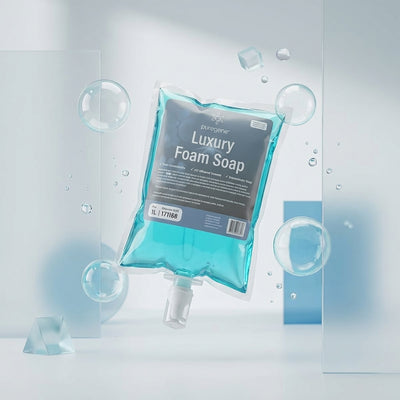 Puregiene Luxury Foam Soap Refill — 1L, Auto Dispenser, Carton of 6
$186.71 inc GST
Buy 10+ and save $18.68 each
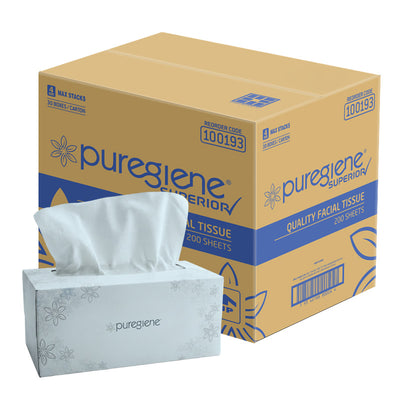 Puregiene Facial Tissue Superior — 2 Ply, 200 Sheet, Carton of 30
$62.55 inc GST
Buy 10+ and save $6.26 each
 Puregiene Jumbo Toilet Tissue Virgin — 2 Ply, 300m, Carton of 8
$43.79 inc GST
Buy 10+ and save $4.38 each


