How Often Should a Commercial Office Be Cleaned? Cleaning Frequencies by Area

Most commercial cleaning schedules are built around a number rather than an outcome — three cleans a week, five cleans a week, a nightly service. The number usually comes from a tender response or a contract written years ago, not from how quickly each area of the building actually gets dirty.
Frequency is what decides whether a workplace still feels clean at 3pm on a Friday, or only looked clean at 7am on Monday. This guide sets out the cleaning frequencies our commercial teams work to across offices, washrooms, kitchens and floors in Newcastle, Lake Macquarie and Sydney, and the consumables that determine how often you need to reorder.
Quick answer
A typical Australian office with 20 or more staff needs daily cleaning of bins, washrooms, kitchen benches and high-touch surfaces, weekly vacuuming of low-traffic carpet and a deep clean every one to three months. Offices under 10 staff usually hold a good standard with three services a week.
Cleaning frequency chart by area
The chart below is the minimum we would accept on a commercial site, and the frequency most Australian offices settle on once foot traffic and visitor expectations are taken into account. Treat the middle column as the floor, not the target.
| Area | Minimum frequency | Typical commercial standard |
|---|---|---|
| Washrooms and toilets | Once daily | Twice daily in high-traffic or public buildings |
| Kitchen and breakout benches | Once daily | Daily, plus a mid-week detail clean |
| High-touch surfaces (handles, taps, switches, lift buttons) | Once daily | Twice daily |
| Bins and waste | Once daily | Daily, with food waste collected twice daily |
| Hard floors — entry, kitchen, washroom | Damp mop daily | Daily mop, machine scrub weekly |
| Carpet | Vacuum traffic lanes daily | Daily vacuum, deep clean every 6–12 months |
| Desks and shared workstations | Weekly | Daily in hot-desk environments |
| Internal glass and partitions | Weekly | Weekly to fortnightly |
| High-level dusting and air vents | Quarterly | Monthly to quarterly |
| Exterior windows | Twice yearly | Quarterly |
Two things drive almost every deviation from this chart: the number of people using a space, and whether the space carries food, waste or bodily fluids. A ten-person office with a kitchen behaves more like a forty-person office than like a ten-person office without one.
How often should a commercial office be cleaned?
Office cleaning frequency scales with headcount and layout. A team spread across a single open floor with one kitchen generates far less cleaning load per square metre than the same headcount split across three levels with three kitchens, three bin runs and three sets of washrooms.
Up to 10 staff
Three services a week is usually enough, provided each visit covers bins, washroom servicing, kitchen wipe-down and vacuuming of the main traffic lanes. The risk with three visits a week is the gap: Monday morning inherits everything Friday afternoon created. Schedule one of the three visits on a Monday so the week starts from a known baseline.
10 to 50 staff
Go daily. At this size the compounding daily load — bins, kitchen benches, washroom consumables, entry floors — exceeds what a three-day service can reset. A daily clean should also be split by task rather than treated as a single block: daily tasks stay daily, while detail work such as skirtings, vents, internal glass and upholstery rotates through the week.
50+ staff, hot-desking and client-facing sites
Daily cleaning stops being the ceiling and becomes the baseline. Buildings at this scale generally need a daily service plus a day presence for washrooms, kitchen reset and waste through the middle of the day. Hot-desking environments also shift desks from a weekly task to a daily one, because nobody owns the desk and nobody wipes it down.
Washroom cleaning frequency
Washrooms are the single most judged area of any commercial building, and the one where frequency shortfalls show up fastest — a washroom cleaned at 6am and not touched again reads as dirty by mid-afternoon.

Every day
Fixtures, seats, partitions, door handles, taps, soap and towel dispensers, mirrors and floors should all be cleaned and disinfected at least once daily, with consumables restocked on the same visit. Restocking is not an optional extra: an empty soap dispenser turns a clean washroom into an unclean one within an hour.
Every week
Weekly work covers descaling of taps, shower heads and urinals, machine scrubbing or mopping of grout lines, cleaning of vents and exhaust covers, and a full wash of partitions and walls. Descaler belongs on a schedule of its own because hard water in most Australian capital cities and regional centres deposits scale continuously.
Monthly and periodic
Monthly work includes deep cleaning of drains and traps, machine scrubbing of tiled floors, ceiling and high-level dusting, and checking that sanitary and hygiene units have been serviced on schedule. Sanitary bin servicing and washroom hygiene units typically run to their own service agreement rather than the cleaning frequency.
Kitchen and breakout area frequency
Office kitchens are the second-highest-risk area after washrooms, and the one most often under-scheduled. They carry food, moisture and waste in a small footprint.
- Daily: benches and sinks wiped and sanitised, microwave exteriors, fridge handles, bin emptied and liner replaced, floors swept and damp mopped, dishwasher run and emptied.
- Twice daily: food waste removal where a kitchen serves more than about 30 people, or where the building has a café or client catering.
- Weekly: microwave interiors, fridge shelving check and discard, splashbacks, cupboard fronts, kettle and toaster bases, skirting behind benches.
- Monthly: full fridge defrost and internal clean, range hood and filter degrease, behind-and-under appliance clean, drain treatment.
A kitchen with a shared fridge and a coffee machine needs a daily service almost regardless of headcount, because both create spill and odour that spread beyond the kitchen floor.
Floors, carpets and entrances
Floors carry the most visible soil and the most traffic, and entrances decide how much of that soil enters the building in the first place.
Hard floors
Damp mop entry, kitchen and washroom floors daily; vacuum or dust mop open hard floor at least twice a week. Machine scrub weekly in food areas and monthly elsewhere, with a strip and seal cycle every six to twelve months depending on finish and traffic.
Carpet
Vacuum traffic lanes daily and open areas at least twice weekly, then deep clean every six to twelve months. Entries, meeting rooms and reception should be deep cleaned on the shorter end of that range, because that is where soil accumulates fastest and where spot treatments are most often needed.
Entrances
Entrance matting does more for cleaning frequency than almost any other purchase. Adequate matting length captures soil before it reaches the floor, and in wet weather it is the difference between a mop-and-bucket response and a full-day strip. Check matting condition quarterly and replace when the pile is flattened.
Bins and waste handling
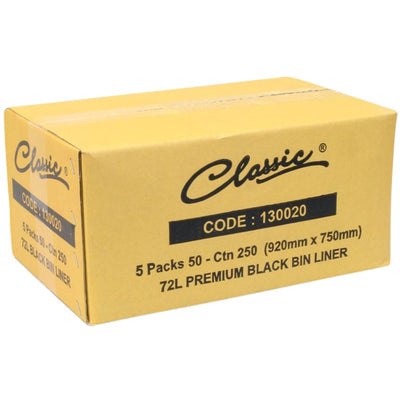
Bins should be emptied daily in offices, and twice daily where food waste is generated. The liner is part of the frequency decision: an undersized liner splits, leaks into the bin body and turns a thirty-second task into a wash-out.
Match liner capacity to bin capacity, keep a small buffer rather than stretching a smaller liner, and hold a par level of at least two weeks of liners on site so a missed delivery does not stop the service. Choose a liner that matches the bin capacity with a little buffer, and keep at least two weeks of liners on site so a missed delivery does not stop the service.
What changes the cleaning schedule
Staff density and layout
Headcount per square metre is the strongest predictor of cleaning frequency. Two hundred square metres shared by eight people and two hundred square metres shared by thirty are not the same cleaning job, even though the floor area matches.
Industry requirements
Healthcare, childcare, aged care and food service sites bring their own frequency obligations, usually driven by infection control rather than appearance. Where a site handles food, bodily fluids or vulnerable people, follow the relevant health guidance rather than a generic office schedule — the Department of Health environmental health guidance is the sensible starting point.
Weather and season
Wet weather roughly doubles entry cleaning load. Winter also lifts washroom and touchpoint frequency, and pollen season adds to hard floor and ledge work. A schedule with no seasonal flex will always fall behind for two or three months a year.
Building hours and access
After-hours access changes what is possible in a single visit. Where a site can only be serviced outside ordinary hours, check the shift and penalty provisions that apply under the Cleaning Services Award before committing to a frequency that requires unsociable hours.
Building a schedule your team can follow
Zone the site and colour code the tools
Split the building into zones — washrooms, kitchen, office, entry — and assign colour-coded cloths and mops per zone so a washroom cloth never reaches a kitchen bench. Beyond the hygiene benefit, zoning makes a frequency schedule auditable: each zone has its own task list and its own sign-off. Our guide to setting up a colour coded cleaning system covers the colour allocation and the storage that keeps it honest.
Write time and task standards, not just frequencies
A frequency without a time allocation is a wish. Each task should carry an expected duration so that a daily clean of 400 square metres is recognisably different from a daily clean of 4,000. This is also the only way to compare quotes properly: two suppliers offering five cleans a week are not offering the same thing if their task lists and minutes differ.
Set consumable par levels
Every frequency decision has a consumable consequence. Daily washroom cleaning for 40 staff consumes soap, towels and liners at a predictable rate, and running out mid-week undoes the clean. Set a par level per area, check it on each visit and reorder on the par, not on memory.
The consumables that set your reorder cycle
Frequency and consumables are the same problem viewed from two directions: the more often an area is cleaned, the faster you consume chemicals, cloths and liners. Three products cover most of the daily frequency workload in a commercial office.
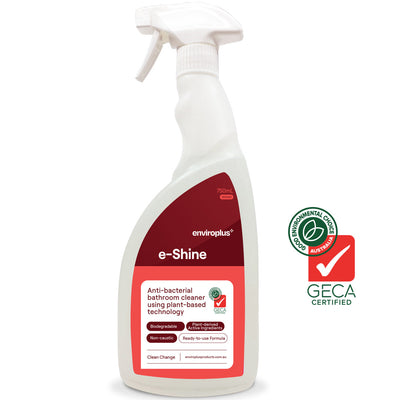
Washroom: Enviroplus Bathroom Cleaner e-Shine — 750ml
A ready-to-use lactic acid formula for daily washroom work. It removes soap scum, body fat residues and hard water marks, and it descales as it cleans, which is what a daily frequency actually needs — not a heavy-duty product that has to be diluted and rinsed on every visit.
Surfaces and touchpoints: Enviroplus Concentrated Multipurpose Surface Cleaner e-Surface X — 1L
A biological concentrate that keeps working on porous surfaces between visits, breaking down fats, oils, grease and other organic matter rather than only lifting visible soil. For sites on a three-day frequency, the residual action is the reason the fourth day still looks acceptable. It dilutes economically, so a single litre covers a lot of daily touchpoint work.
Waste: Classic Bin Liners — 72L, Carton of 250
The everyday liner for office and kitchen bins, sized for standard 72 litre bins with a leak-resistant film and flat-pack dispensing. A carton of 250 covers a mid-size office for months at a daily frequency, which is the right way to buy a consumable you use every single visit.
If you are still assembling the base kit for a site, our office cleaning supplies checklist maps products to the areas covered in this guide.
Frequently asked questions
How often should a commercial office be cleaned?
An office with 20 or more staff should be cleaned daily, covering bins, washrooms, kitchen benches and high-touch surfaces. Offices under 10 staff can usually hold a clean standard with three services a week, provided bins and washrooms are done on every visit.
Is daily cleaning necessary for a small office?
Not always. A small office with fewer than 10 people and no food service can usually maintain a good standard on three cleans a week. The exceptions are offices with a shared kitchen, visitor traffic or a reception area, where daily bin and washroom servicing is still the practical minimum.
How often should office carpets be vacuumed?
Vacuum traffic lanes daily and open carpet areas at least twice a week. Have carpets deep cleaned every six to twelve months, or sooner in entries and meeting rooms where soil loads are highest.
How often should office bins be emptied?
General waste bins should be emptied daily. Kitchen and food waste should be collected at least twice a day, and sanitary and hygiene units serviced on a scheduled frequency that matches their servicing agreement.
How often should a commercial washroom be cleaned?
At least once daily, and twice daily in buildings with heavy staff or public traffic. Every daily clean should cover fixtures, touchpoints, floors and restocking, with descaling and detail work scheduled weekly.
What cleaning frequency should a 100 square metre office have?
A 100 square metre office with around 10 staff typically needs three cleans a week, including bin emptying, washroom servicing, kitchen wipe-down and vacuuming. Frequency should rise to daily if the space is client-facing or has a shared kitchen.
Next step: set the frequency, then stock for it
Work out the frequency area by area first, then buy to that frequency. A daily washroom service needs a ready-to-use bathroom cleaner and a reliable towel and soap supply; a kitchen needs a degreaser and twice-daily waste capacity; a carpeted office needs a vacuum that will survive daily traffic-lane work.
If you would rather start from a working kit than build one product at a time, browse the full range and filter by area: shop commercial cleaning supplies. Orders over the bulk threshold ship at carton rates, and our team can help match consumable par levels to your cleaning schedule.
Shop this guide
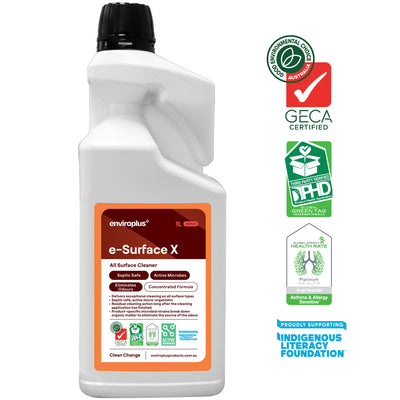 Enviroplus Concentrated Multipurpose Surface Cleaner e-Surface X 1L Each
$65.00 inc GST
Buy 10+ and save $6.50 each