Commercial Disinfectant Wipes: Australia Buying Guide 2026
What are the best disinfectant wipes for commercial facilities? Choose TGA-listed hospital-grade disinfectant wipes for high-touch surfaces in healthcare and workplaces, and food-safe wipes for kitchens and food-prep areas. For everyday office and retail use, bulk antibacterial wipe cartons give the lowest cost per wipe and keep refill frequency down.
Disinfectant wipes are the fastest-growing segment in commercial cleaning — and for good reason. They combine a cleaning agent and a disinfectant in a single pre-moistened sheet, so staff can sanitise a surface in seconds without mixing chemicals, measuring dilutions or storing spray bottles. For facility managers, that means faster turnover of touchpoints, fewer chemical-handling risks and more consistent disinfection outcomes.
But “disinfectant wipes” is a broad label. A wipe rated for hospital theatres is overkill for an office kitchen, while a general antibacterial wipe won't satisfy food-safety auditors in a commercial kitchen. This guide breaks down the types of commercial disinfectant wipes available in Australia, how they're regulated, and how to choose the right one for your facility.
Contents
- Types of commercial disinfectant wipes
- Hospital-grade disinfectant wipes
- Food-safe and food-contact wipes
- Heavy-duty and antibacterial wipes
- How to choose the right wipes
- Cost per wipe and bulk buying
- Touchpoint cleaning best practices
- Frequently asked questions
Types of commercial disinfectant wipes
Disinfectant wipes fall into three broad tiers, each suited to a different level of risk. Matching the wipe to the environment is what separates an effective, audit-ready program from wasted spend — and it's the first decision any facility manager should make.
Hospital-grade disinfectant wipes
Hospital-grade wipes are the top tier. They're formulated to kill a broad spectrum of bacteria and viruses — typically to the TGA's “hospital grade” standard — making them the default choice for healthcare settings, aged care facilities, gyms, childcare centres and any high-traffic workplace where infection control matters.

In Australia, disinfectants that carry specific kill claims are regulated as therapeutic goods, so look for a TGA listing when compliance is non-negotiable. The V-Wipe Hospital Grade Disinfectant Wipes Tub 100 delivers hospital-grade disinfection in a resealable tub, ideal for reception areas, treatment rooms and shared equipment. See our full hospital-grade disinfectant guide for the complete compliance picture.
Food-safe and food-contact wipes
Food-safe wipes are tested for incidental food contact, so they can be used on surfaces where food is prepared and served without leaving harmful residues. In a commercial kitchen, a wipe that isn't food-safe could transfer chemical residue to benchtops, cutting boards and utensils — a critical food-safety failure that can trigger a breach under HACCP requirements.
Reserve food-safe wipes for front-of-house tables and back-of-house prep areas, and pair them with a colour-coded cleaning system to prevent cross-contamination between food and non-food zones.
Heavy-duty and antibacterial wipes
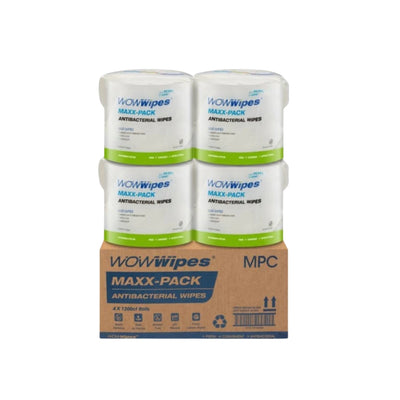
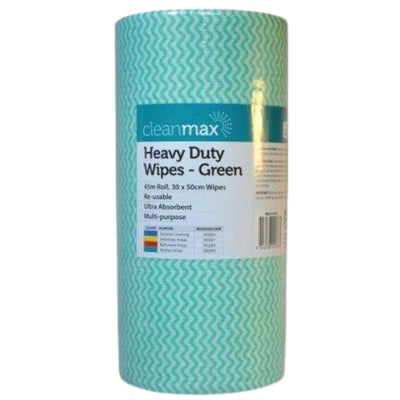
For general-purpose touchpoint cleaning in offices, retail and light industrial settings, antibacterial wipes offer the best balance of performance and cost. Bulk cartons like the Wow Wipes Anti-Bacterial Wipes carton of 4,800 bring the per-wipe cost down dramatically and keep refill frequency low, while heavy-duty rolls such as the Cleanmax Heavy Duty Wipes Green 45m roll handle grime, grease and heavier soiling on machinery, benches and high-wear surfaces.

How to choose the right disinfectant wipes
Regulatory compliance (TGA)
Check the label before you buy. Wipes that claim to disinfect must be listed with the Therapeutic Goods Administration (TGA). For food-contact applications, look for a “food-safe” or “suitable for food contact” claim. If you clean healthcare or aged care surfaces, hospital-grade is the minimum benchmark — general antibacterial wipes won't meet the standard.
Surface compatibility
Not all disinfectants suit all surfaces. Quaternary ammonium (quat) and alcohol-based wipes are generally safe on sealed hard surfaces but can dull certain plastics, acrylics and screens over time. Test on an inconspicuous area first, and avoid bleach-based wipes on stainless steel and coloured fabrics where corrosion or fading is a risk. Refer to Safe Work Australia guidance for managing hazardous cleaning chemicals in the workplace.
Format: tubs, rolls, cartons and dispensers
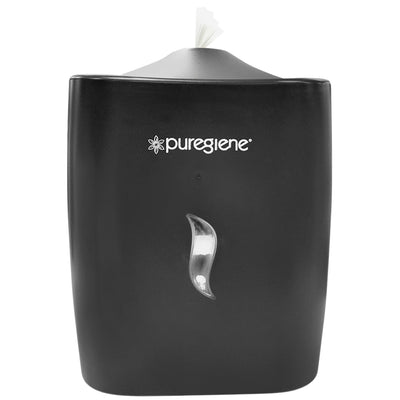
The right format depends on where and how often wipes are used. Tubs suit fixed stations such as reception desks and treatment rooms. Wall-mounted dispensers keep wipes at the point of use — the Puregiene wall-mount wipe dispenser is a popular choice for kitchens and washrooms. Cartons and rolls offer the lowest cost per wipe for high-volume cleaning teams that refill multiple stations daily.
Cost per wipe and bulk buying
Disinfectant wipes are a consumable, so the true metric is cost-per-wipe, not price-per-pack. A $39 tub of 100 wipes works out to about $0.39 per wipe; a $206 carton of 4,800 wipes drops that to roughly $0.04 per wipe — a ten-fold difference that compounds across a multi-site operation. Estimate daily wipe usage per workstation and touchpoint, then buy the largest format your storage and usage allows. Bulk cartons also cut ordering admin and protect against stockouts during flu season and supply disruptions.
Touchpoint cleaning best practices
- Clean before you disinfect. Wipes clean and disinfect in one pass, but heavily soiled surfaces should still be pre-cleaned so the disinfectant can reach the surface.
- Respect contact time. The surface should remain visibly wet for the dwell time specified on the label — this is when disinfection actually happens.
- One wipe per area. Don't stretch a drying wipe across multiple touchpoints; once it's dry or visibly soiled, use a fresh wipe.
- Wipe in one direction. Avoid re-contaminating cleaned areas by folding the wipe and working in a single direction.
- Dispose correctly. Disinfectant wipes are waste — never flush them, and follow your facility's colour-coded and hazardous-waste procedures.
Frequently asked questions
Do disinfectant wipes need to be TGA-approved in Australia?
Wipes that make specific disinfectant or kill claims are regulated by the TGA and must be listed. If compliance is non-negotiable — such as in healthcare or aged care — choose a TGA-listed hospital-grade wipe and confirm the claim on the label before purchase.
Can I use the same wipe for kitchen and bathroom surfaces?
No. Use separate wipes — ideally colour-coded — for kitchens and bathrooms to prevent cross-contamination. In food-prep areas, use food-safe wipes; reserve hospital-grade wipes for washrooms and high-risk touchpoints.
How should I store bulk disinfectant wipes?
Store wipes in their original sealed packaging in a cool, dry place away from direct sunlight and heat. Always reseal tubs and dispenser lids after use so the active solution doesn't evaporate and reduce effectiveness.
How often should high-touch surfaces be wiped?
High-touch surfaces such as door handles, light switches, lift buttons and shared equipment should be wiped at least once per shift in busy facilities, and more frequently during cold and flu season.
Stock up on disinfectant wipes for your facility
Whether you need hospital-grade compliance, food-safe confidence or low-cost bulk antibacterial wipes, Matthews Cleaning Supplies stocks the full range. Browse our hospital-grade disinfectant wipes, bulk antibacterial wipe cartons and wall-mount dispensers, or contact our team for bulk pricing on cartons and multi-site rollouts.
Shop this guide
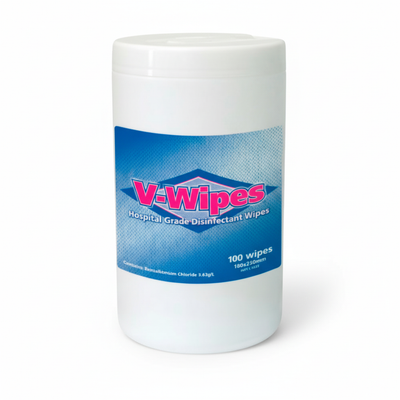 V-Wipe Hospital Grade Disinfectant Wipes Tub 100
$39.10 inc GST