Commercial Recycling Bins: Complete Australia Guide
Every Australian workplace generates waste — but how you collect and separate it determines whether you pay inflated landfill levies or run a lean, compliant operation. The foundation of any waste program is a clear set of commercial recycling bins. In this guide we cover the four standard colour-coded waste streams, how to size and place your bins, why sanitary disposal bins are a separate legal requirement, and how to match each bin to the right liner.
Quick answer: Commercial recycling bins are colour-coded, heavy-duty containers used in Australian workplaces to separate waste streams at the source. A standard setup uses four streams — blue for paper, yellow for mixed recycling, red for general waste and green for organics — sized to your daily volume and paired with matching bin liners.
Table of Contents
- Why Colour-Coded Recycling Bins Matter
- The Four Standard Waste Streams
- Choosing the Right Size and Placement
- Sanitary Disposal Bins: A Separate Compliance Requirement
- Match Your Bins to the Right Liners
- Frequently Asked Questions
Why Colour-Coded Recycling Bins Matter
Source separation — sorting waste where it is produced rather than at a central facility — is the single biggest lever for cutting your commercial waste costs. Landfill levies in New South Wales, Victoria and Queensland continue to climb, and each state's waste strategy pushes businesses toward mandatory separation of organics and recyclables. Colour coding turns that obligation into a reflex: staff and cleaners don't need to read a policy, they just match the colour.
Australia's colour conventions follow AS 4123.7, the standard for mobile waste containers, and they line up with the kerbside colours most people already know from home. When your workplace bins use the same colours as the council system, contamination drops sharply — and contamination is what gets recycling loads rejected and sent to landfill anyway.
Colour-coded bins also slot directly into a broader colour-coded cleaning system, where the same discipline is applied to cloths, mops and buckets to prevent cross-contamination between areas. For the bigger picture on what happens to commercial waste, Planet Ark's Business Recycling hub is the go-to reference, and the Department of Climate Change, Energy, the Environment and Water publishes the national waste policy that underpins the colour standards.
The Four Standard Waste Streams
Most Australian workplaces standardise on a four-stream system. Here's what belongs in each — and the bin we stock for it.
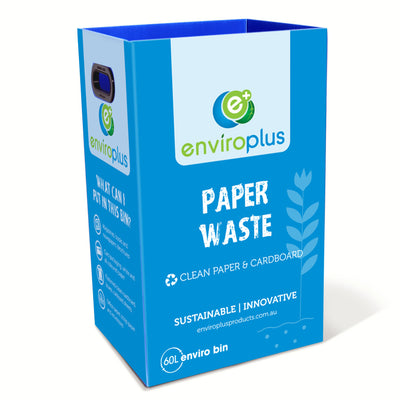
Paper & Cardboard — Blue
Office paper, newspapers, magazines, flattened cardboard and clean paper packaging. Keep this stream dry and clean — food-soiled paper belongs in general waste. The Enviroplus Envirobin Paper Waste Blue — 60L uses a clearly marked blue body so there's no ambiguity at the print station or mailroom.
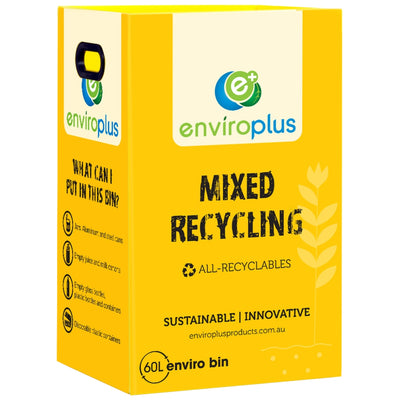
Mixed Recycling — Yellow
Rigid plastics, glass bottles and jars, aluminium and steel cans, and cartons. This is the highest-volume stream in most offices, so it's the one worth sizing generously. The Enviroplus Envirobin Mixed Recycling Yellow — 60L is our workhorse — pair it with a yellow lid for a fully colour-matched station.
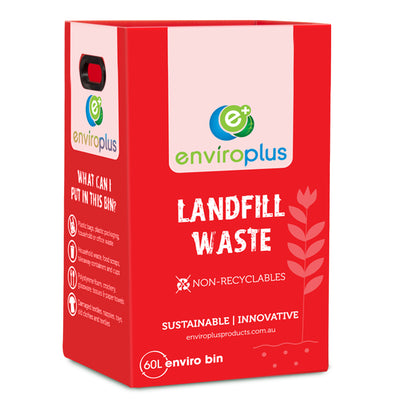
General Waste (Landfill) — Red
Everything that can't be recycled or composted: soft plastics, food-soiled packaging, broken ceramics and polystyrene. Keeping this stream as the smallest option is a proven way to nudge people toward recycling. The Enviroplus Envirobin Landfill Waste Red — 60L makes the landfill stream unmistakable.
Organics — Green
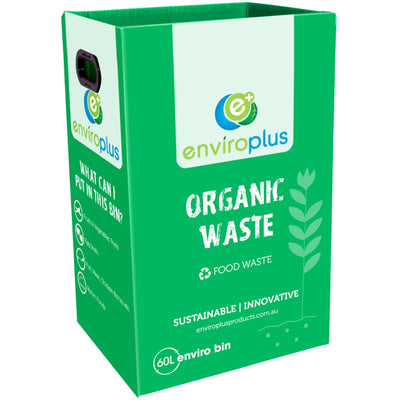
Food scraps, coffee grounds, tea bags and compostable packaging. If your site has a kitchen or lunchroom, organics separation is often mandated once you pass certain waste thresholds. The Enviroplus Envirobin Organic Waste Green — 60L is designed for the task — and remember organics bins need compostable liners, not regular plastic.
Choosing the Right Size and Placement
A 60-litre bin is the sweet spot for kitchens, print stations and shared workspaces — large enough to avoid constant emptying, small enough that a full liner is easy to carry. As a rough guide, a 20-person office generates roughly one 60L general-waste bin and one 60L mixed-recycling bin per working day.
Placement matters more than most people expect. Bins should sit where waste is generated — kitchen, lunchroom, printer and meeting rooms — not tucked in a corridor. Every extra ten metres between a desk and a recycling bin measurably reduces sorting compliance. Keep a recycling bin physically next to every general-waste bin so there's always a correct alternative.
Sanitary Disposal Bins: A Separate Compliance Requirement
Sanitary bins are a distinct category from recycling and general waste. Under workplace health and safety obligations, female and unisex washrooms must provide a sealed, hygienic disposal unit for sanitary items — and the unit must be serviced, not emptied by general cleaning staff.
Look for a foot-pedal or lift-lid mechanism that keeps hands away from the opening, a sealed lid for odour control, and a dedicated liner. Our Puregiene Sanitary Bin with lift lid and foot pedal is the touch-free option we recommend, and it takes standard blue sanitary bin liners. The Terracyclic 26L starter kit uses a refill cartridge that combines the lid and bag, so it doesn't need plastic liners at all.
Match Your Bins to the Right Liners
Every bin is only as good as its liner. Match the liner to the bin size — a 60L bin takes a 60–80L liner so it sits flush without overhang — and choose the material by stream. General waste and recycling use standard black or clear liners, but organics must use compostable liners or the whole bin gets rejected at the composting facility. We stock the Enviroplus Compostable Bin Liners — 80L for exactly this purpose. For the full sizing breakdown, see our bin liner sizing guide.
Frequently Asked Questions
What colours are commercial recycling bins in Australia?
Australia follows a consistent convention under AS 4123.7: blue for paper and cardboard, yellow for mixed (commingled) recycling, red for general waste, and green for organics. Some councils use slight variations for glass or e-waste, but the four core streams are standard nationwide.
What size recycling bin do I need for my office?
Most shared areas run well on 60L bins — one per stream per high-traffic area. Small teams under ten people can start with a single recycling and single general-waste bin; larger floors should add a station per kitchen, print room and meeting cluster to keep sorting convenient.
Are sanitary bins required by law in Australian workplaces?
Yes — under workplace health and safety duties, employers must provide hygienic sanitary disposal facilities in female and unisex washrooms. The units must be sealed, odour-controlled and regularly serviced by a licensed provider.
How do I reduce contamination in my recycling bins?
Three things move the needle fastest: keep the four colour-coded streams consistent with council colours, place a recycling bin beside every general-waste bin, and use clear signage showing what belongs in each stream. Audit contamination monthly and retrain around the most common mistakes.
Ready to Kit Out Your Waste Stations?
A well-designed bin setup pays for itself in lower landfill levies, higher recycling rates and fewer rejected loads. Start with the four colour-coded streams, add sanitary bins to your washrooms, and match every bin to the right liner. Shop the full waste and recycling range at Matthews Cleaning Supplies — or reach out and we'll help you spec the right stations for your site.
Shop this guide
Written by
Jordan MatthewsCommercial cleaning specialist at Matthews Cleaning Company. Our expert team draws on years of hands-on field experience to help businesses choose the right tools and chemicals for every cleaning challenge.